
ISBN: 979-8-950930-19-5
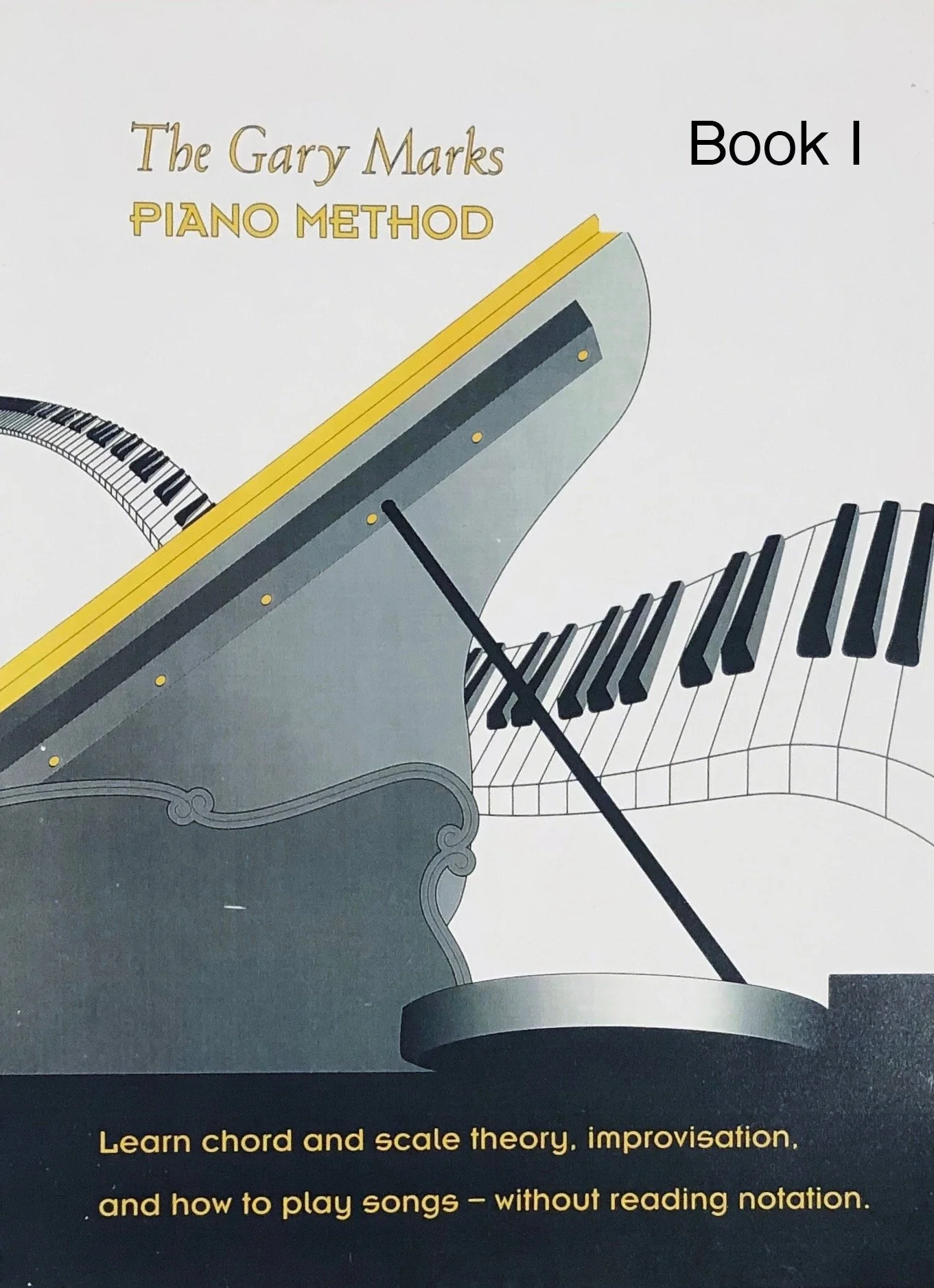
The Gary Marks Piano Method, Book I: Improvise on Piano Without Reading Notation
1990
Learn chord and scale theory, improvisation, and how to play songs - without reading notation.
Piano Method Book I and Audio: $15.00
The Piano Method Book I is in PDF format, 119 pages
Each chapter is accompanied by an audio component in MP3 format.
Following your purchase, please fill out the contact form here to receive your audio download.
How to Improvise on Piano Without Reading Notation
The Gary Marks Piano Method Book I teaches chord theory, scale theory, and piano improvisation through what Marks calls structured free play. Created to match one full semester of college with weekly lessons, the book focuses on reading chord charts, and singing and playing through modern songs. No written notation is required.
All five dimensions of learning are placed in context: tactile, visually looking at the keyboard, audial, theoretical, and emotional.
The Method and Mentors
Marks developed this approach over five decades as a pianist and songwriter. His own piano education began after recording his debut album, Gathering, when he asked pianist Michael Cochrane to teach him. Instead of notation, Cochrane taught him jazz theory and improvisation, the foundation of jazz and of the way Marks would write music for the rest of his life.
His second teacher was equally influential. After moving to California, Marks heard Art Lande's album Red Lanta (ECM Records), immediately sought him out, and asked him to be his teacher.
Lande became one of Marks's biggest musical collaborators. He played on Marks's second album, Upon Oanda's Wing, and his band, Rubisa Patrol, played on Marks's third album, Thoughts of Why, with Lande insisting Marks play piano on all the tracks. Marks also introduced Lande to David Samuels and Paul McCandless. Lande, in turn, introduced Marks to Eberhard Weber and his wife, Maja.
Maja, a cover art designer for a number of ECM albums, offered to design the front cover of Upon Oanda's Wing, an album that, decades later, was reissued in Europe and Japan with her beautiful artwork still on the cover.
Do I Need to Know How to Play at All?
No. If you can keep pitch when you sing and have a piano, you have enough of a starting point. On the other end of the spectrum, if you are an advanced player of classical music or any other style, Marks can take you deeper into the theory of improvisation and songwriting.
Praise From Composer Terry Riley
The book's introduction includes a blurb from composer Terry Riley, a pioneer of minimalist music best known for In C and A Rainbow in Curved Air, who praised the method's structure of learning through free play and improvisation theory, calling it "the first and last lesson for all musicians."